Day 69 of 100

A hundred day plan is a fine looking document on day one. By day sixty it tends to live in a slide deck that somebody updates the night before the steering meeting, full of circles that are mostly green.
If you built a twin of both companies for diligence and kept it running after close, you don't have to draw a second picture. In the demonstration deal, where the made-up Corvane buys the equally made-up Kettle Lake Fluidworks, the same definitions that judged the target before signing measure it every month afterward. The integration team can track its work against the problems diligence found, instead of inventing a new set of measures after closing.
On day 69, 17 of the 28 milestones are done. Of the 19 that should be finished by now, 17 are, two are late and two later ones are already at risk. Through month two the benefits the deal promised came in at $129,000, against $113,000 planned, which the screen puts at 115 percent.
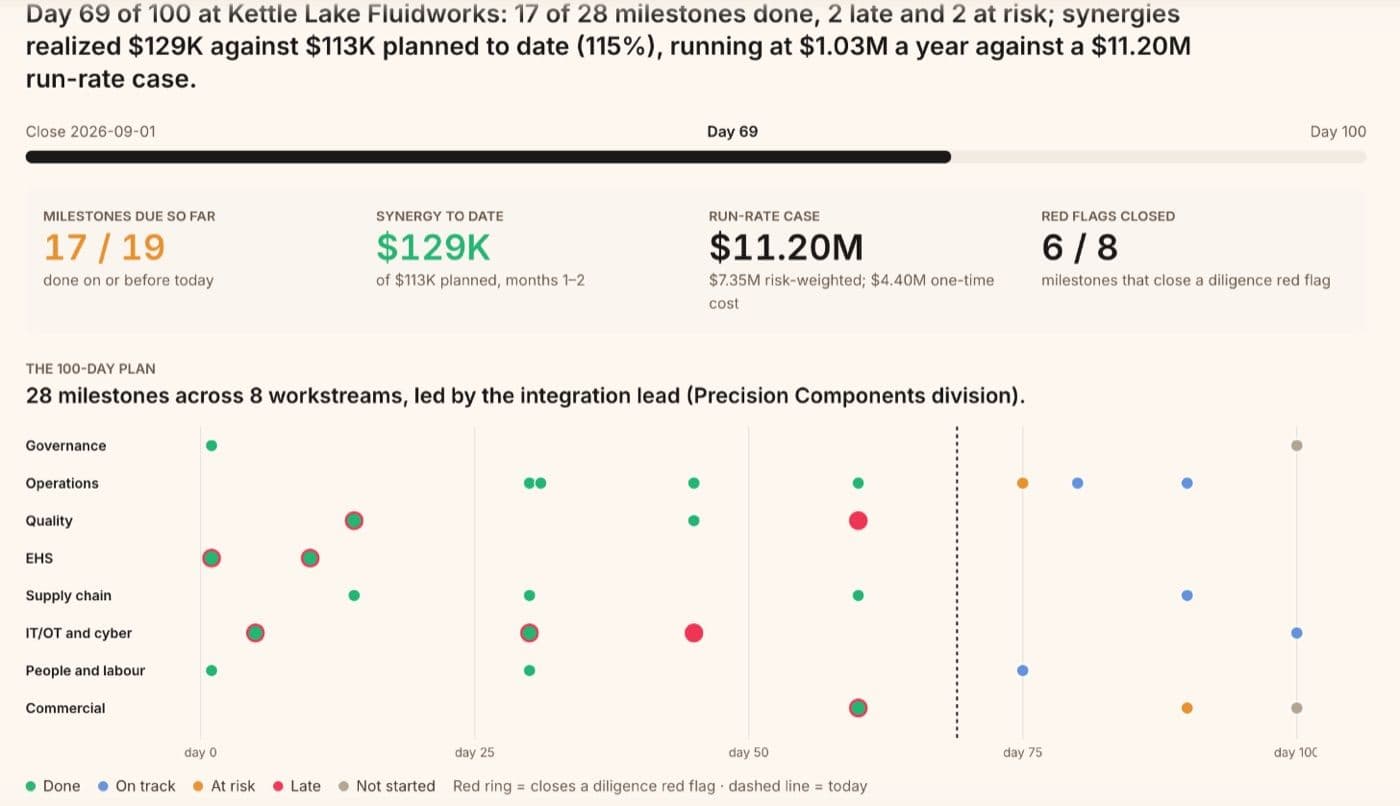
The same demonstration after close: the 100 day plan at day 69. Red rings mark milestones that close a diligence red flag. Every company and figure is made up.
That is encouraging and it is also small. The annual run rate is $1.03 million against a full case of $11.2 million, or $7.35 million after weighting for risk, with $4.4 million of one-time cost to get there. Kettle Lake came into the deal with $11.6 million of adjusted EBITDA, so the full case asks for nearly that much again. About $7.8 million of it comes from items that weren't scheduled to start until after month two. Being ahead early says little about those, and I'd be spending real time on the assumptions behind them.
The plan also marks, with a red ring, which milestones are meant to resolve a serious finding from diligence, so those can't quietly drift off into somebody's other priorities. Six of the eight are marked done, and done on a chart still leaves the question of whether the risk has gone away.
I wouldn't leave either of the other two until the next steering meeting. One is the network around the New Tarrow test stands, which diligence found sitting on the office network and which was due to be separated by day 45. The other is a stem seal leak at the largest customer, a quality report that had already been open for 140 days when it was found, and was due to be closed and accepted by day 60. That customer is 23 percent of Kettle Lake's revenue, about $21 million a year, and had put new designs on hold. The buyer got their consent and a three-year extension before closing, and a joint account plan is marked done, but I'd want to know who owns the quality problem, what has been assigned to it and when the customer expects to be satisfied.
In When Two Companies Collide, Mike Carroll suggests asking which decisions in the combined firm will disappear instead of moving, and how many hops it should take to settle a quality conflict between plants. With the stem seal work overdue, I'd ask whether the person accountable for closing it has the authority to redirect engineering and production time across both companies, or whether that still has to pass through several management teams.
At the next integration review I'd spend less time on the 17 finished milestones and more on what is holding up these two, and I'd ask for a benefits forecast that shows what depends on what.
Disclosure: I've been working with the Humble team. Corvane, Kettle Lake and every figure shown are made up for demonstration.