The Data Room Said 95 Percent

Every acquisition has a data room, and every data room has an on-time delivery number in it that somebody worked hard on. I don't assume the number is a lie. It is usually measured the way that company has always measured it, which might mean on time against the second date they promised, or yield counted after the rework has quietly gone back through. Then the deal closes, the buyer starts counting the buyer's way, and everybody acts surprised.
A digital twin tends to get shown as a 3D pump rotating nicely on a screen. For an acquisition I'm more interested in a working model of how each business runs. Both companies' plants are described the same way, each is fed from its own records, and one set of formulas does the arithmetic, so a buyer can compare them before spending weeks reconciling spreadsheets, and keep comparing them after the money has moved.
There is a demonstration company in Humble that I've been using to show this. Corvane Consolidated Holdings is made up, and so is Kettle Lake Fluidworks, the business it buys. Every figure here is invented, which is the one time I'm happy to say that about a deal model.
In the demo, Corvane's Erie plant needs more fittings capacity and a wider range of valves. Kettle Lake has two plants, Cobalt Harbor and New Tarrow, that add 11 million fittings and 1.9 million valves a year, with 140 part numbers that overlap. On paper it is a tidy fit at $104 million, or 8.1 times reported EBITDA of $12.9 million. The quality of earnings work finds customer rebates being paid out of a balance sheet account, EBITDA comes down to $11.6 million, and the multiple becomes 9.0.
Buyers routinely challenge how a target calculates its earnings, and I'd want the same discipline applied to the operating numbers behind the investment case. In the demo, twelve months of Kettle Lake's raw records were rebuilt into the shape of Corvane's daily safety, quality, delivery and cost numbers.
At Cobalt Harbor the data room showed 95 percent on time and in full. On Corvane's definition it is 79, because Kettle Lake had been measuring against its own re-promised dates and Corvane measures against the date the customer asked for. First pass yield goes from 98.9 percent to 94.6 once a trip around the rework loop counts as a defect. OEE drops from 81 to 65 when changeovers and planned maintenance go back into scheduled time. The recordable injury rate climbs from 1.9 to 3.3, and behind it are restricted-duty cases that had been logged as first aid. New Tarrow moves the same way.
That answers whether the target ran the way it was described. The buyer also needs to know how far it is from home, and Erie runs at 92 percent on time and in full, 98.4 percent first pass yield and 93 percent OEE. Before any of that gap goes into the investment case, somebody has to work out what it would take to close it. A common definition also doesn't prove the records underneath it are right, so someone still has to go and check them.
The same screen shows conversion cost per thousand good units, $2,843 for Erie against $3,553 for Cobalt Harbor, which is worth chasing once product mix is accounted for. New Tarrow makes valves, and the screen says plainly that its figure can't be compared with a fittings plant's.
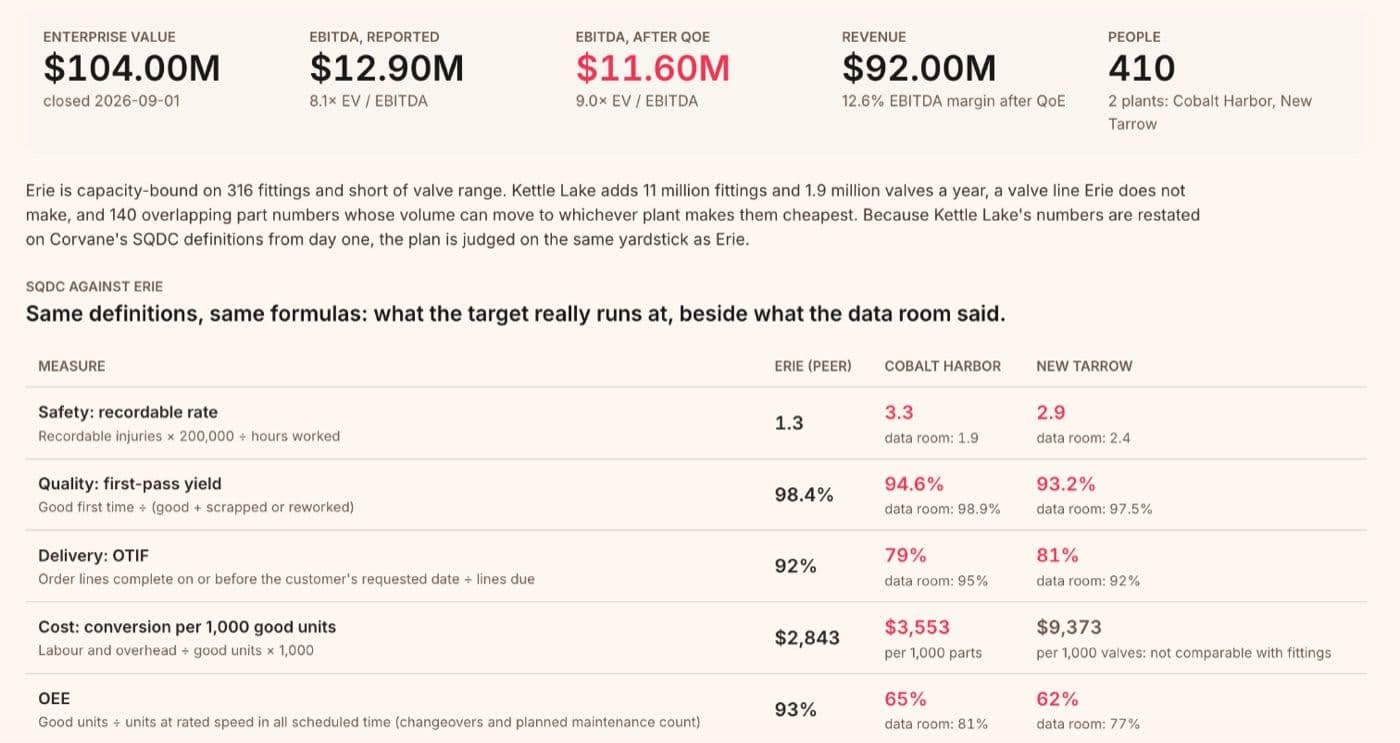
The demonstration deal in Humble: Kettle Lake restated on Corvane's definitions, beside what the data room said. Every company and figure is made up.
None of this necessarily kills the deal. It may change what the buyer is willing to pay, how much improvement the investment case can fairly assume, and who needs to be standing in the plant on the first morning. In the demo the largest customer, 23 percent of revenue, can also walk on a change of control, so their consent and a three-year extension become a condition of closing. That settles the contract and leaves an open quality problem with the same customer, which is waiting for whoever shows up on day one.
Mike Carroll makes the harder argument in When Two Companies Collide, which is that a merger turns on whether the two operating architectures can live together. Consistent operating data won't tell you whether two companies can work together, but I'd rather have that discussion with both sets of numbers on the table, and before committing the money.
Disclosure: I've been working with the Humble team. Corvane, Kettle Lake and every figure shown are made up for demonstration.